Pages

Sunday, June 9, 2013

Sunday Harvest/Garden and Yard - June 6th

"The best laid schemes o' mice an' men,Gang aft a-gley"  - Robert Burns.

For those non-geeks, or those not of the Scottish persuasion 'Gang aft a-gley' roughly translates to 'go often awry' -  back in the 90's you could use it to 'out' all the wannabe Scots that came out of the woodwork after BraveHeart hit the cinemas.

Anyone who's followed recent posts (both of you), know I'm up for a busy few weeks - between the upsurge or people needing work done on their properties, and the blueberry harvest, this time of year whizzes on by at a fast clip.  Lucky for me it's also the time when there really isn't very much you can do until July; Summer planting for Autumn.
At this time there's a lot of things that get a little behind and need to be caught up on, and Sunday seemed like a good day to play catch up.  Pool maintenance, mowing, composting, cleaning up the yard.  The plan was to then unleash the kids in the pool for a few hours and weed/fertilize (yep STILL haven't fertilized)/harvest then let them inside. They'd crash out - I could catch up the laundry and a few other bits, and we could eat dinner and watch Game of Thrones.... bliss.

Well it seems the weather had other plans.  The kids got about 30 mins in the pool, and everything past that point went out the window.   Wow! yes! My path is underwater!
This was about 10 mins after it started to come down, so as you imagine it was pretty heavy.  It's since past, but it's too dark to take any decent pics of anything.
I'm just hoping it stays clear so I don't have to reshuffle my work schedule.


That's a pretty big bean!
I did brave the thunder for 5 minutes to grab the full grown beans. We won't be eating them tonight, but I wouldn't want to leave them on the vine too much longer. Again, consistently getting bigger and in greater quantities.
This was a single weeks growth, and all the plants still continue to bud and flower.
I also grabbed some kale, trimmed from the lower leaves of the 3 sizable plants.  My bowl was overflowing with a goodly amount (enough to stuff a gallon sized ziploc bag - wilted down it was a dinner side dish for 3)
To look at the plants you'd never know they were trimmed, so this will be a regular on the plate for a little while.


The propagation containers have overflowed with water several times.  With all the rain the blend of soil that was turned over and mixed has nearly self sorted back into it's respective groups.  I was going to write it off and start again when I noticed that the kale I'd put in there on the 5th had already sprouted.  Blew my mind since it's planting window by hardiness zone was passing (May being the last month) - so a few bonus plants that may find their way into the main garden!
With the way things went this Spring, I've got a little ways before the Summer yielding plants kick in, so I'm sorry to say this may be the 'beans and kale show' for another week.


My 'holdover pepper' from last year, the last of the Garden #2 peppers, is putting forward some nice lil green fruit.  The other new plants are doing fairly well - some get more sun than others, and the ones that get more shade seem to be doing much better.  Either way the shaded plants are still getting PLENTY of sunshine throughout the day.  I'll be trying to narrow down what squares will keep them best over winter if I can.  I'd gladly forfeit some of the shadier ones near the house for near permanent plants as I'm planning to expand the garden (funds permitting) by another 16 square feet over Summer in time for Autumn, but I'll leave the exact plans on that for another post.


Queen of Hearts are continuing to put out more green tomatoes. They'll ripen up when the heat of Summer starts to hit them - These are not a 'sure thing' even though I've had no critters thus far trying to nom them.  But either way I'll be taking seed from these plants.  They grew to a nice size in a container, haven't branched out all over the place, and seem to put out a nice sized fruit for what I want. If I could get another 5 of these planted I'd be making pasta sauce all Summer long.

Ok a crap blurry photo, but the sun had gone and the rain looked like it was coming back. The butternut squash is meandering across the concrete slab at the end of the driveway (where I currently store a bunch of junk) and has put out this nice sized lil squash. With the rain and the sun I'm hoping this keeps growing.  If I only get a single squash off this plant I'll consider the experiment a success.  The regular summer squash are producing, but it's small early squash that hits the dirt and rots out before gaining any size - I'm hoping this will change in the very near future. All things considered, squash in containers is going along AOK, the only thing I'd change is perhaps trying to buy or build larger self watering pots.


Potatoes are starting to yellow up, and in the 'tater pot' one of the plants has already died off. This isn't a bad thing! At this point all the remaining energy is going into the tubers that are formed to finish them off. I could harvest lots of baby potatoes at this point if I wanted to (oh and how I am tempted!) but I'm still in the process of testing the 2 systems in my somewhat unscientific comparison (the next test will be a LOT more objective - this one was very ad-hoc and had several things out of my control).
Potato-wise in Georgia the weather and seasons are such that we are supposed to be able to do 3 crops of potatoes in a year - A Spring planting, a late Summer planting, and an Autumn planting that although won't put out full sized spuds, should be able to give you new potatoes at Christmas - something I'm certainly going to be trying.
In my next planting I'm going to be adding a couple more crates to continue what looks like a good method for me, while the original and the tater pot go head to head once again.  I really want to get more going in the 'tater department as I plan to have this as the 'entrance point' of new soils into the system. I'll rotate the soil out after a potato harvest to be used to top up or fill new containers and squares.

One thing I want to try  that is still within my time-frame deals with corn and polyculture.  I'm all about getting as much as I can from every square foot, and if I can get it to take on part of the garden maintenance, then I'm there!  When I planted corn this Spring, it was something I'd  had on my mind since last Autumn. I'd planted beans and peas there in order to rotate the corn in. The beans/peas put nitrogen into the soil which the corn needs and takes up in the next planting.  The Native American Indians had been doing this one better for centuries - the '3 sisters', planting corn, beans, and squash together was an absolutely brilliant example of plants looking after each other in several ways, and sharing the work of the farmer.  The beans climb the corn, the squash leaves shade the roots and prevent weeds, the beans give back nitrogen.
Now I can't put my squash with my corn (for spatial reasons), and I use bush beans rather than pole (climbing) beans,  but I can still use part of the principle - increasing the bean harvest while at the same time giving much needed nitrogen to the corn.  This is something I overlooked when I planted and had since brushed it off as 'too late' - but reviewing my seeds today I found the variety I'd bought as a replacement actually should be planted right now.... so this is one experiment I can still try this season... I'll be going more in depth on this 'happy mistake' in a future post on seeds and planning.

Anyways that's the weekly Garden update.

Cheers!


Saturday, June 8, 2013

Got Time for Lunch? Barely!

It never ceases to amaze me how far the myth that cooking takes enormous amounts of time has permeated our society. It blows my mind.  I've cooked for myself for nearly all of my adult life.  This was looked upon as an impressive feat when I was a bachelor (note to younger single guys - knowing how to cook a couple of decent dishes will buy you a LOT of forgiveness in areas you are lacking), and people have always said things like 'oh I'd do that, but I don't have the time' or 'it's just more convenient to pick up something' - and my favorite 'oh it's cheaper'.

Several years ago when I lived in Vegas I offered a friend a steak dinner - to which he said, "I'm really really hungry right now, I'll just go down to a local McFastFood and be back in a bit". I had all the ingredients out and ready at the time, and a bet was born.  I put up $50 that I'd be eating by the time he came back.  He took off to the local drive through (and this is the Las Vegas suburbs, there were several within a few blocks to choose from) , and I fired up my pan.  By the time he returned with his bag o food I had already started eating. A medium rare steak with onions, steamed brocolli, corn and some mashed baby potatoes.  Once you factor in driving, waiting, ordering, driving back - he'd been gone 20 minutes.  I was $50 richer and he got a double dose of butthurt by missing out on steak.  If I really wanted to make him cry I'd have told him that if I factored in portion cost, I spent less money as well.

Anyways. Today.  Lunchtime to be exact.  I got home from the first day of harvest around 10:30pm last night. I've spent my morning catching up things that have fallen behind while I've been busy (most of last week). I'm sore, I'm tired, and I'm hungry. Ravenously so. The kind that needs to be sated with the greatest of urgency. In this situation many people would fish the 5's and singles from the wallet and get the car keys.  I go to the back yard.

Doing a quick look over what I need to get done once the midday sun passes (mow, compost, weed, fertilize) I do a bit of quick picking. The lettuce looks like it's growing up rather than out - it's probably going to bolt.  Radishes are looking like they're coming close to an end, so 2 of them. A couple of leaves of kale from one of the larger plants, a quick rummage around the beans - I want the larger beans for tomorrows dinner veg, so a few of the smaller tender beans for a salad - or steaming - or both!

Coming back to the kitchen door I grab a few sprigs of parsley, some greens from chives and garlic.  Hmm, a salad would be nice - but would it be filling enough? I could steam, but it's a hot day...  The good thing about cooking your own - you don't need to compromise.  I trim out the lettuce, cut up the radishes, take a half of one Kale leaf, the smaller beans and a little parsley- mix them up and put them in the fridge.
What's the best, fast, easy and filling thing to use as a base for some steamed veg?  Rice.

 The simplest thing in the world to make and yet people look at it like its some enigma of cookery, spending a small fortune in instant, 5 minute, and boil in a bag varieties - pointless.
Straight normal rice - easy as 1,2,3 - get an amount of rice (any amount) add twice it's volume in water to a pot with a well fitting lid. for 2-3 people, 1 cup of rice = 2 cups of water. Add some salt and a tiny bit of oil to seperate the grains.  Put the lid on and bring to the boil then immediately reduce the heat and let it go on a soft boil for 15 minutes.
remove from the heat, add a few slivers of butter, put the lid back on and let the remaining steam finish it off while it rests for 5-10 minutes.   20 - 25 minutes is all it takes. Perfect rice not stuck to the pot just about every time.

Crappy blurry photo for no extra time or effort!
Well and good, but what about the steamed veg? Even if (like me) you put the rice on and prep everything else (and clean up after it) you STILL need to do the veg? - newp.  Not at all - you can have it all with NO additional time and next to zero extra effort.  Instead of letting the steam just finish the rice - let it steam the veg as well.
If like my you like lightly wilted and things like beans to still have a little snap to them, add the veg when you take it off the heat.  If you like them a little more wilted and soft, one or two minutes before you'd take it off - add butter then veg then - let it finish out for a couple of minutes, take it off the heat and let rest for 5.  Like I said, next to no effort and all the flavors from that veg and herbs will go through the rice.

 I need a new camera!
Plated up - salad on one side and rice on the other - finish off with some Italian dressing and a dollop of ranch to dip on the side.
This might be a little misleading - as there was actually enough for 3 plates... Fresh cooked lunch in 25 mins.
Your milage may vary, but that beat a Las Vegas McColostmy Crappy Meal and the local branch of Dominus Pizza (yeah, you won't even get name placement with me) .

Point being:  It was no more inconvenient for me to prep a filling fresh lunch than it would have been for me to go buy an overprocessed crap one.  Cost wise was nothing, as I keep rice as a kitchen staple at all times (who doesn't... ok maybe a few of you young bachelors - in which case read this article from the top AGAIN and pick up my subtle tip).
In the larger economic sense of 'cost', being 'opportunity cost' I would argue that one of these things has me getting my shoes, settling the kids, leaving the house, and being stuck in a car. Not exactly 'fast'.  While the other has me in the kitchen, continuing about my daily business and still having time to see to the kids miscellaneous needs. Although the time to cook and prep was 25 minutes, it still didn't take me away from the things I was doing. In fact 15 of those 25 minutes was spent doing other things.  Which makes you wonder about the how we're redefining 'convenience'.

Cheers, and happy Saturday!


Wednesday, June 5, 2013

Here Comes The Rain Again...

Yep, just like the song!  Over the past couple of years I've been tuning into Southern Georgia's seasonal cycle.  Mid April into May the last few years you have lots of rain, driven in from both the coastal weather and from large storms in 'tornado alley' in the mid-country. Between those and the warming temps from March onwards, it makes for a usually brilliant spring, where planting is a breeze - and you get wonderful early harvests of garden veg as early as May.  This is how it's been since the kids were born.   This year, however, has thrown a bit of a curve ball.
The early rains were sparse, and now while playing catchup I've found myself using town water more than I thought I would - and the morning humidity and the occasional shower, followed by temps now in the 90's make things like spinach sprout then instantly fry.

I had been hoping for some more overcast days and a bit of the wet before I had to go out on harvest at the farm, if for nothing else than to make sure the garden was good and watered before I have to leave it alone for a week.  Well - be careful what you wish for!  A big storm with high winds moved through last night, and I'm left glad that I'd been trying to organize my garden timing and logistics around things like this.

My temp rainwater tub - 50 gallons
It only took 5 minutes last night to go from empty to full with the rainwater tub - I only have rain guttering on one small part of the roof (over the back door) - that's quite a bit of rain.  It only took another 20 minutes after that for the  swimming pool to go from it's minimum level to hitting the overlow at the max.


The new corn took a bit of a hammering.  Although by the time I got around to taking these pictures it had started setting itself to rights.  I gently pushed the stalks back into place afterwards and put fresh soil around the bases.


Yep that lettuce that had been nearly ready for transplant was also hammered . If today didn't start overcast I would have woke to see it burnt to a crisp.  Despite that, some of these were transplanted to the garden proper anyways. I figure this late Spring I have very little to lose by putting them in.


The ever-half full composting frame chugs along! it's been weeks since I first showed it, and each week I've been putting in shredded paper, large cardboard, leaves from the magnolia and grass clippings - yet every week it stays at the same level - half full.  By next year I expect some nice compost out of the bottom, and with something procured to sift and sort it - I might be at the stage where I won't have to purchase potting mix at all... Composted cow manure will still be on the shopping list though - I could get it for free and compost it myself (I have the connections) - but at 2.50 for a 40lb bag - to be honest it's worth it to buy as needed.

So with more rain threatening to come down hard again, I figured there was no time like the present to put in a little work and get things ready to change gears.  The window has truly shut on several of the more delicate spring greens - and there's no point lamenting it.  The time for direct planting in the garden has also passed.  The plan for Spring/Summer I think was fairly solid, but a few mistakes on my end and a bit of strange weather behavior threw a spanner in the works. I'll be tweaking it and trying again next spring.
The plan, as it stood, was to plant out around 1/2 the garden with 'fast plants' and salad veg, while having the other half taken with up with 'slower' plants - those that will put out over the summer.
Even though there were stumbling blocks, such as the attachment to leftover plants like Swiss Chard and Beets (just wait ONE more week, they'll come good! I'm SURE of it!) and late planting of a lot of things (some things I should have planted as early as January - others no later than March), I still got a fair bit out of the run - and plenty was learned.

Any day you don't learn something is a day wasted.  And as I tend to think we learn more from our mistakes, I won't be beating myself up over the ones I've made.... just so long as I don't make the same ones again!

Spring, like Autumn is the time for planting. Summer and Winter are for the ripening of their respective crops - and if you've planned it right in Spring, you'll be getting things through Summer.  So with  under 20 days till Summer starts, we sweep the board clear and change directions.
Starting with the emptying of the overflow containers:

No point crying over a lack of Rosemary or wasting time trying to plant more cilantro - the overflow has plenty of sage and chives that are healthy and good sized. Any available space in the herb garden is planted out with them. I'd rather have plenty of a few things than a little of several - especially if it means garden space that isn't pulling it's weight.
So far I've been pulling plenty of Basil from this bed, and when you consider the cost of fresh herbs - I easily get $5 worth every few days. There's PLENTY. And the more you trim, the bushier it gets - I might try making some pesto at this rate. Sage is catching up and I'll have lots of that on hand pretty soon as well.

From the clump of cherry toms (you see in the lettuce picture) - several were put into spa pots I had set aside. Leaves were pulled back and they were planted the depth of the pot.  The nature of tomato plants will hopefully give them a solid root base.  The pots were filled with composted cow manure and a good handful of worm castings.  These ones I know vine all over if you let them, so keeping them in pots keep them contained and not have them overrun everything else.


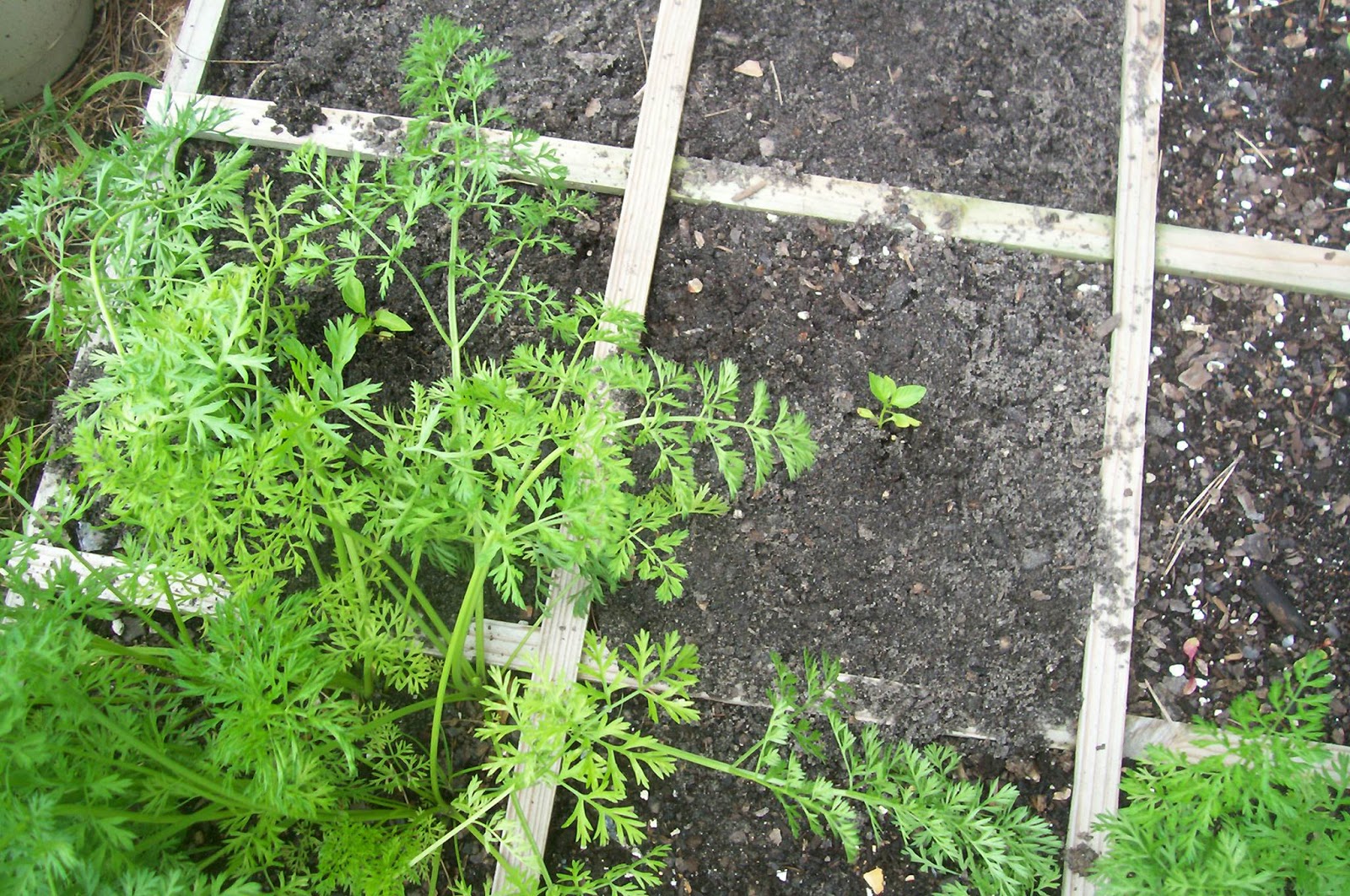
 Hard to see with the massive carrot tops, but peppers were transplanted into the failed lettuce squares.
Here I deviated from the 'no planting seed' and filled out a couple of squares with the 'queen of hearts' hybrid tomato seeds, in pots they are a very managable plant, and I don't think it's too far out of the time frame for them to come up.  If I do it will be a nice bonus, but I have my bases covered in other ways if they don't.

Even the tiny leftover squash plant got a new home.  This circular bed I made for a blueberry plant that got knocked over at the farm. I knew it only had a 25% chance of making it, but this way I'd have a place set aside at the end of the year if new plants become available.  If I get them from the farm I will be getting a self pollinating plant - if I buy them from a WalMart, or similar, I need to get 2 to have fruit. This soil may be too acidic for the squash, even though it's in it's own pocket of potting mix.  But it was plant here or get thrown away. Nothing ventured, nothing gained.

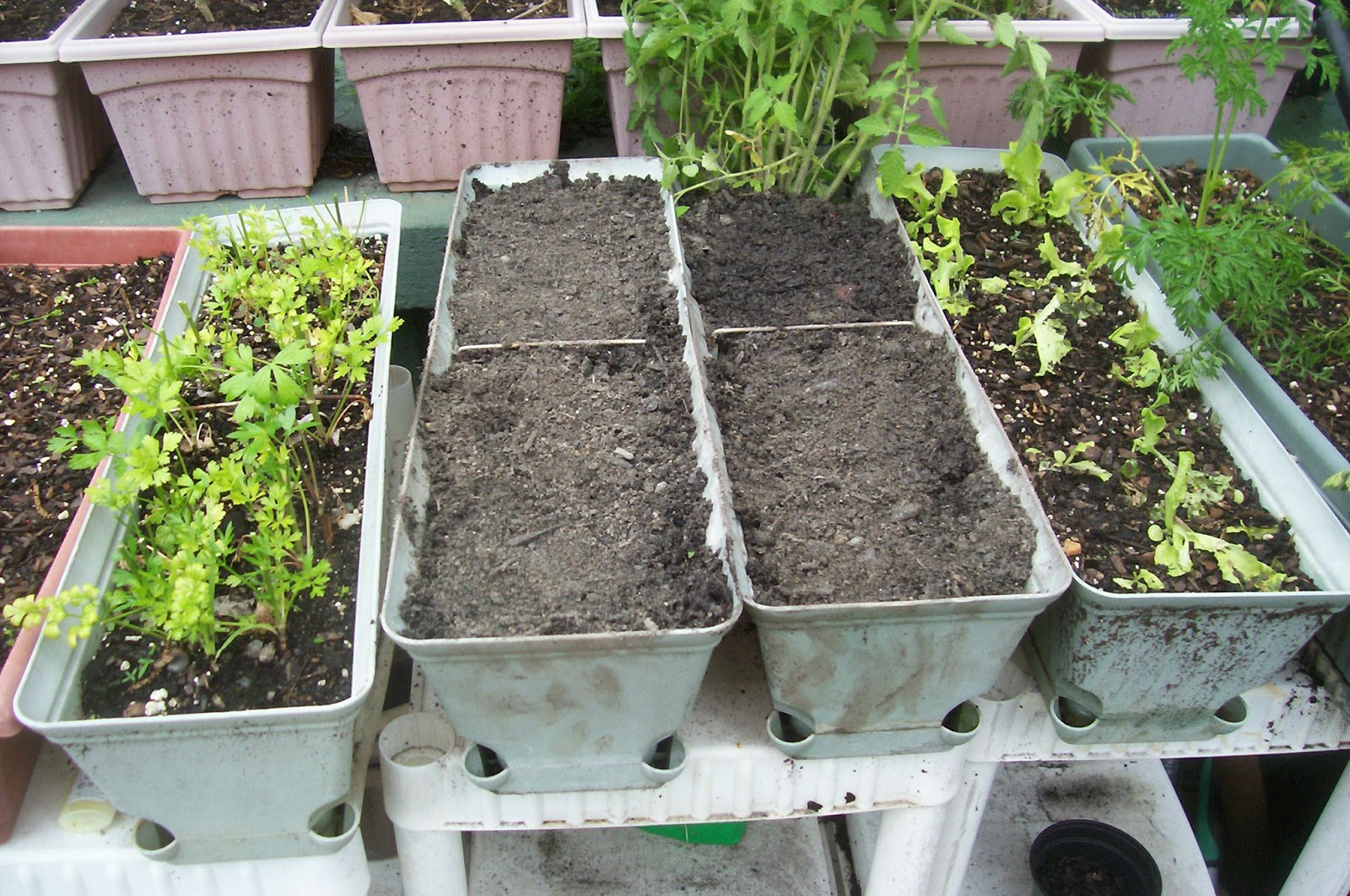
 The planters I used for overflow will now be repurposed for propagation. No more lettuce will be planted though - what I have, if it doesn't burn up, will be transplanted to the garden as fully grown ones are pulled.  The others have been amended, turned, and planted out with kale and peppers.  In the past (Garden #1) I planted peppers late in the middle of summer and still had them produce nicely all the way till winter, and Kale has proven to be worthwhile addition as a speedy substitute for broccoli or cabbage. Having some to replace the ones I pull out will be cool.  Cherry tomatoes are still up the back of the container, where they'll stay until I find space or if they fruit I'll use them to take seed for next year.   The parsley in the container next to them I decided to keep, but gave it a haircut.  I have my fresh parsley in the herb garden, so I'll keep this around to stock up on dried herbs for winter.

All herbs that have been producing more than I used were trimmed up, along with the very last of the snow pea pods.  They've been put in brown paper bags and tied up with a rubber band and stored in my closet under the stairs. The AC intake is there so there is constant fresh air movement - it's dark, and it's cool. I've dried out herbs in there already and it's worked out well.  I'll probably store potatoes in there as well if I need to (wishful thinking that there will be a surplus!).  2 ways to dry herbs. Either in a brown paper baggy (I save mine when I go to the gas station for this and that) and shake them up every few days (change bags if they get dampish) and they should dry out in no time. This is a good way to do it if you have a log of stuff to dry and little time on your hands. Another way (one I use when I DO have time) is to trim up your sprigs and gather them into bunches, collect them at the base and wrap a rubber band around them, and hang them upside down from clothes hanger using a clothesline pin.  Again, put in a dark cool place, and leave for a few weeks.  when they are dryed out, cut them up and put them in a sealable container (like a glass jar - I have lots of them from the baby food days) or even an empty spice jar you've saved.. the good thing about that is that it's already labled :P

Looking to Summer, it's a time for things that have been planted to come good - Tomatoes, Peppers, Eggplants, Squash are all on the menu as it stands - but for these to hit their potential I'll have to be looking towards better watering and fertilizing solutions. I have a few ideas in the works, and look forward to documenting a few low-tech/low-cost DIY projects over the coming months.

As I finish typing this up it still hasn't rained, but you know the second I go out and water the transplants it will come down cats n dogs :)

 But for now I'll just relax, watch the sun set, and enjoy some fresh green bean casserole and let the weather sort itself out.


Monday, June 3, 2013

From Garden To Plate

The best part of having a garden set up is enjoying your food fresh. Sometimes as fresh as it can possibly get.  If you're not going to cook it - why bother?  Be it rummaging around lunch time to quickly steam down something over rice, or cooking a main meal, there's very little that can trump it both in taste and satisfaction.
It can be fun too - my wife says it reminds her of Chopped when I come in with half handfulls of random things and say 'hey can you do anything with this?' - just as fun when I roll up my sleeves in the kitchen and cook up what I've grown myself.  I'm an adequate cook, though my skills reside in baking. I am always willing to give something a try, and keep trying till I get it right.

1/4 chicken with green beans and kale.
 Once the kids finally settled last night, we settled in to eat dinner. It was way past when I'd published the last post, and I had planned on some food posting today.  Beans and Kale were steamed in the chicken juices with some fresh garlic, and the Chicken was prepped with thyme, basil, and parsley.. all fresh.
The kale was quite nice - I hadn't tasted it before and thought it very tasty. I'd like to try it next by itself, to get a feel for where it's natural flavor lies (and by that get a better idea of where it fits in a meal).

Turnip greens were ready for the pull today, and my first trial was less than what I'd call successful. They tasted good but at some point I got a mouthful of something bitter as anything and it really left an unpleasant aftertaste for me.  My wife said it was alright, and the bitterness was part of the appeal, but I think she was being kind... In the language of my homeland I would describe the taste as fuck awful. I'd have to either fix it or just not grow them again.
Doing some yardwork for my wifes Grandma I brought up the subject, and between her and my Mother-in-law I got some good pointers.

  1. Only use the larger leaves, and as little stem as possible
  2. Drain off the greens after they have wilted (so if you're doing a more elaborate recipe - wilt them first)
  3. Add some cider vinegar to your boiling water - a couple of teaspoons
  4. Add some molasses or brown sugar to your boiling water (just 'a touch').
 So that huge pile of greens were washed and selectively cut down - the better sized roots (which had a zesty radish flavor) were cut down as well.  Water was boiled with a splash of apple cider vinegar I keep for my baking.
All the scraps were bagged up and put in the freezer - as I do with all garden and fruit scraps. A very important part of the process and worth reminding folks about.
Rather than thinking of the garden as dirt and plants - think of the entire system as a single unit. We want to keep it as closed and self functioning as we can - because we are conserving that energy, we don't want to be constantly topping it up.  If you have a bottle of milk you use what you need, right? Despite the old saying of  'crying over spilled milk' you don't just splash it over everything if you can help it.  It's a waste.  Same thing with the garden.  Just because we personally can't eat the offcuts, peels, or roots of something doesn't make them useless - giving as much of what isn't used as possible to the woms lets me put nutrients back into the soil as quickly as possible.  Nutrients that can be used to grow other things.  I don't look at those scraps as inedible - I look at them as my next pepper, tomato, or lettuce.  If we keep as much as we can within the whole system, we need to spend less time and money topping it up. 

Now back to our scheduled program:

I kept the greens recipe as basic as possible this time. I wanted to taste the greens by themselves, and determine if this was something I wanted to keep growing. 
The pile was overflowing my pot, but wilted down in about 20 minutes.  Greens were strained - the pot rinsed and restarted with salted water. Again a splash of vinegar was added, and I had no brown sugar or molasses - so a generous cap full of cane syrup was used.
The greens simmered after that for another 20 minutes as my wife was given a handful of other stuff from the garden - some peas, herbs, carrots. She started her loose shepherds pie.


As it turned out the greens were very nice, with an earthy taste similar to what you'd get from spinach, but not as strong as with swiss chard / silverbeet.  The sweetener of the cane syrup was undetectable and the bitterness was now replaced with a pleasant 'tang' that stayed with you. Actually it added to the shepherds pie I think, which was already very nice from the start.

Finishing out I baked a banana bread, as I had a few overripe bananas that were just right for the task... I might have a slice in a little bit - but it's going out to the farm with me tomorrow for Granny, as payment for her advice.

Meals fresh from the garden are a lot of fun in the kitchen. They can challenge you to try new things, enjoy some quality time in the kitchen with your significant other, and the food just plain tastes better.

Sunday, June 2, 2013

June 2nd Harvest - Garden/Yard Updates

A couple of landscaping jobs came up this week giving me some sun, fresh air and exercise. It also gave me a few dollars to put into the yard and garden kitty - but spring/summer is a time to focus on the yard, and me doing the odd landscaping job while having a rubbish area of dirt and straggly grass around the kids pool was getting on my nerves - so I spent a little time and money prettying it up. I still have to put down some more pine bark and a couple of concrete pavers - but I think it's looking much better!
The garden feeds the body but the yard feeds the soul. So time and money well spent if you ask me.

Out With The Old / In With The New.


A couple of changes around the garden and as the fast/immediate plants start to slow, the longer ones start to come in - and production overall seems to be chugging along.  Although weather, circumstance, and a few boneheaded errors got my Spring off to a shakey start - I think even my penchant for overthinking and snatching defeat from the jaws of victory may be thwarted by Nature - I think she has a soft spot for me to be honest.

Beans, you've seen the bed a hundred times - so just a harvest pic. Even better than last week. It amounts to very full quart sized ziploc bag of beans.  My wife tonight is going to be (cross fingers) making up a bean casserole (one of my fave dishes of hers and one of the reasons I wanted to grow as many beans as I could).  We'll also be trying some other produce from the garden, but more on that later.

Peas have made their last hoorah and died out.  The spring heat was just a little too much for the variety of asian snow pea that I grow and love.  This of course finally explains why when I planted them in garden #2 they failed to take off - I planted them in Spring.  It's an interesting lesson in learn-by-doing as the packet said they were fine for this zone in Spring - and although I got a small tupperware container full of shelled peas, and a lot of snack pods while working in the yard, it was in no way comparable to the Autumn / Winter harvest.  Would I do it again?  YES - although not 2 squares - and there's a reason:  I've had those seeds for some time, and the variety I really like, however I've not been able to source them again locally - none of my regular go-to places have that variety stocked, and the last seed I had went into the garden (because I'm boneheaded).  Now when I pulled the plants I pulled up what I thought was a weed, but turned out to be a half buried brown pod that had fallen down between the plants - it had sprouted 2 plants from the 3 peas inside.  It was a bittersweet moment as I had told myself 'save these next pods for seed' but no more came - and I'd found these two while pulling up the plants, and them.. Now the heat would have killed them off in no time flat, so even had I recognized them and let them grow, I still wouldn't have gotten anything. The happy ending to this tale was tucked up the back of the overflow container. A solitary, stunted, pea vine, in the final stages of going from green to brown. But it had flowered and actually produced 3 very small pods containing 8 peas.  This little wonder gave me the exact number of seeds to start a new square out in Autumn, and if I don't track down new seed - I'll plant those out and use them solely to stock up for next year.  Even if only half of them sprout they could potentially produce enough seed to last me a couple of years.

In it's place has been planted some Kale and some Broccoli from the overflow container, the squares amended with the newly attained worm castings.  I took the opportunity to replace a pepper plant that succumbed to the heat and a couple of other things.

Carrots are hard to guess - the tops can look great but as you can see - not really an indication of what's going on below - and once pulled, that's it... Putting them back in the ground is a 50/50 I've found.  I pulled 2 to see where they were  at.  A little disappointing - but it tells me to change a couple of things. No more going over them with the foliage spray anymore (I cut back on root crops once they have established, but obviously not enough here) - also I need to cut back on their water.  Having the water sink deeper will force them to grow longer. These carrots are in a bed that's dug down a foot deep, so there is ample grow room for them.  Radishes are slowing down a little, and one of the squares has been replanted with an Eggplant from the overflow - I'm curious to see how it does.  I have one in a container already so it will be fun to compare them.  Again no pics of the bed as we have ample - Turnip Greens are still getting bigger, which reminds me; Last week I cooked Turnip Greens with Ham Hocks and Dumplings - the result was on the whole pretty good.....however I did get a few bites that were WAY bitter.  Now it was my first time cooking with them, but a visit with my mother-in-law, and my granny (in-law?) gave me the following tips:

 #1 no matter what the recipe says, wilt down your greens then throw away that water. Base the rest of your dish on fresh water and add the wilted greens to that.
#2  A "touch" of sugar (a teaspoon or two I'm guessing by that) will knock the last of the bitter out of them.
I'll get this southern cooking thing down eventually - either way in Autumn I'm growing Collards.

The last of the harvest for today (there are more things to come out, but I'll leave them there till they are ready to be eaten, and do update harvest posts over the week) was this Kale.
I left my hand in there to get the scale of the thing.  My hand is around 8 1/2 inches from the base of my palm to my fingertip, and this is easily 3 times that size.  That would be around abouts 2 feet across.  Broken down it took up 1 1/2 gallon sized ziploc bags. I've never had Kale before, but I tore off a leaf and tasted it raw.  It seemed to me like a very nice blend between fresh broccoli and cabbage (both of which I've tasted raw).  Since I like these two things, we're going to prepare it in a manner suited to both - a steam to soften it. It will go tonight with our roast chicken.  In the prep of that we also have fresh Thyme, Basil, Parsley, and Garlic.
As is becoming the normal Sunday affair, the only thing not from the garden will be the chicken and a few staples in the prep.
If the Kale turns out well I'll certainly be growing more - as something that tastes like cabbage and broccoli (both of which I have growing), it grows a LOT faster than either of them.


That covers the Harvest... now for some updates:

 Squash in a pot seems to be going pretty well - the plants aren't all that big, although the Butternut squash has sent a vine out onto the driveway (which is what I wanted it to do) and a very small squash is already developing there.  The plants are all healthy and seem to be growing fine. I have 2 in self watering pots and 2 in regular pots of the same size (I think they are 5 gallon). I'm going to see which works best for them before I invest in larger pots to upsize them.
As you can see, they already are starting to put squash out - I'm going to have to stay on top of water and fertilizer for these I think.  I'm curious to see what sized veg I get.  As it's all about how much I can grow in as small a space as I can - it will come down to how much attention they need and if I need larger pots for larger veg.  Either way they are putting out more flowers and baby squash than the first planting of them I did in Garden #1 (the successful garden).


 Toms seem to be doing well as well - there's been some growth since last week and the other plants now have some smaller fruits on them too.  The sucker I replanted was knocked out by the heat, and I've not seen any new ones really sprout forth. This has me scratching my head a little and has me rethinking my research last week. I'll be taking seed from these plants (and I'll cover the saving of tomato seeds when I do), I have a doubt in the back of mind about the status of these plants (determinate/indeterminate) and it won't be answered until it's too late to do anything about it - I'll hedge my bets.

Other areas of the garden I'll cover in followup harvests this week as I have to pull Turnip Greens this week (so I get to redeem myself in the kitchen) and I'll be following up the progress of Corn, Peppers and other things. At this point with Summer temps hitting and the Blueberry harvest just around the corner - I'm pretty much locked into the garden at this point, and the time for adding and tweaking new plants or what didn't make it has passed.  It's kind of sad that I missed the window for spinach this year (so it seems) but it's time to switch gears - clear out the overflows so they can be used to propagate plants that are doing well and change over from establishing the garden to running a 'production garden' - which I'll be getting into over the week, time willing.

Happy Sunday!

(As I write this I see lightning in the distance - YAY my rainwater is replenished again!)


Coconut Coir

I've gone on a lot about coconut coir in a lot of my posts - when I first starting using it it was primarily as an addition to my worm composting. I used it as bedding to start out a tray, or put a layer over the top of newly added scraps as a 'seal' against flies or other unwanted pests.
I got a brick with my worm farm, and had already read up on it as a cheaper and renewable alternative to peat moss or sphagnum moss.
Now I use it as a soil additive to improve drainage, soil density, and water retention. I used it as a primary ingredient in my 'potato soil' - the other parts were potting soil and worm castings.
When I get started on the raised wicking bed (making an entire 4x4 garden bed based on the principles of self watering pots) it will play a major part in ensuring the capillary action of the water.
When I started my first worm bin last year in February I bought 10 blocks online for around 2 dollars each (plus I think 6 dollars in shipping) - and I'm down to my last couple of blocks now. 25 dollars well spent, this year I'll be looking into getting double that.

So seeing how it's now a big part of what I'm doing (and I need more very soon) I should show you what it is, how to get it, and how to use it.

In my last post on harvesting the worm bin, if you look carefully at the equipment you can see a brown block near the small containers.. That's a block of coir.

650 gram block of coir
 On 650 gram block, all sealed in plastic and ready to go - it takes up hardly ANY space, and when you add water it expands to more than 7 times it's original size.
Anyone wondering where I get those robust yellow buckets, they're the buckets I get kitty litter in. They've outlasted any other bucket I buy, and I use them for EVERYTHING.  So if the cat is going to be a complete pain in my balls - the very least it can do is supply me with buckets.
Anyways, a picture is worth a thousand words - so here's how it works:

A gallon and half-ish of water, put the brick in.

1 minute later - the block is expanding

At 3 minutes

10 minutes

Give it a hand stir at 20 - 25 minutes.
The camera angle isn't the best - but it fills that bucket up to around 3/4 full from one brick. About what you'd expect to get out of an average size sized bag of peat moss, and at a fraction of the cost.

From here you can use to for anything you'd use peat moss for.  Making a hard soil fluffier, adding to drainage, anything.

Buying Coir

When I first went to buy some I had a hard time tracking it down locally, and when I did it wasn't priced very well. Getting it online worked out really well, but you have to shop around. Google Shopping is your friend here, it will show you a list of product and you can select price range, then you can see who is selling it for what.  There are some things to watch out for - some people set very low prices then double down on the shipping, and if you're not careful you can be paying a LOT more than you bargained for. People are taking advantage of it's growing popularity and trying to make a quick buck of those in green movement.
Me, I'm in the 'cheap ass' movement, so I do my homework.  I'm looking to spend 50 bucks, and I want to get double what I bought for 25 when I started.  This is going to include shipping.
Finding it on google shops at a 2 dollar a block price is easy - but as you see 2 dollars isn't always 2 dollars! 
What I did was go through both products and vendors, one at a time, and see how far I could drive that shipping dollar. Some companies really try and screw you by saying that shipping fee is per block - others don't.   Wayfair  was actually quite reasonable.  Running the numbers on a test run through their checkout shows that the 4.99 shipping is on ANY amount, and as a bonus they have free shipping on orders of $49 or more.... Well I said I wanted to spend 50 buck - which gives me 25 blocks, delivered via fedex ground shipping for a grand total of 49.75.  A quarter under my budget.

Things like that are easy to find and work out if you put a little time and effort in.  Google shopping, Amazon, Craigslist, Freecycle (if you have a chapter local to you - the one here is practically inactive) , sometimes even Ebay, are all your friends if you want to drive your garden budget dollar as far as you can.

Cheers!


Vermicomposting - Happy Poo Day!


The first of the month! I'm lucky it happened on a Saturday as I've been out and about all week with landscaping work - so I'm happy to devote a day to my own yard and especially to the worm bin clean out.  As I've mentioned, some minor issues set my worm compost production back by a month - heck of a thing to happen at the start of Spring, but we've soldiered on with liquid fertilizer only. So although things aren't back up to 100% production, they're much improved.

What it's all about is to get from this:

To this:

And have that happen every month.  Now as you can see there is still stuff in there that hasn't been finished - some of it is bits of packing tape and thin plastics that were attached to things (which I didn't successfully weed out pre shred) - and some of it will be compacted cardboard and paper.  Usually it's a bit more finished than this - but it's a LOT better than what I had last month (where I skipped harvest altogether as it would be a waste of time).
In your own bin you could leave it till it's completely turned over to castings - this would save yourself a lot of sorting time and the quality would be great - for me, I've set my garden up with this as the engine that's supposed to drive it - I can miss a month here and there but ultimately I need all the castings I can get - This month was in the 10lb range, which is on the low end of what I was getting pre new bin hiccups.  Enough to do what I need to get done this month.

So, how do you harvest a worm bin anyways?

With a tower or tier system it's very easy - we take advantage of the worms natural disposition to avoid light to do a lot of our work for us.  It requires a little setup  - so we'll step by step it.

Setting up the workspace - stuff you need.
I like to get myself all setup organized - I sort my bins by hand, which is a bit of a dirty job - but no dirtier than weeding really.  There are people who've made machines to do this process for them, I think they're very cool and I'd like to eventually build one (and when I do - you bet I'll show it here) but that's a project for Winter, and Winters budget.
One thing I should make note of is that my first bin has 5 trays - if I harvest it every month then the scraps in the new level have 5 month to process, the downside is each tray can end up weighing up to 30lbs -so when I move this outside I have to lift around 150lbs and move it from the workshop to the back porch. When I go to remove that bottom tray, it's another 120lb lift.  Let your level of mobility dictate how high you go - better to have several tubs of a couple of trays than a hernia. For instance I suggested to my Mother to leave her system at 2 trays only. She keeps it outside, so she only needs to lift one tray out.  Mind you I'm now the one with the family of 5 and she's got MUCH less scraps that need disposing, so it works out.

Anyways the equipment list
  • 1 container for unprocessed bedding and worms.
  • 1 container for 'undigestables' aka plastic trash
  • 1 small container for things I might want to put back on top of the new bin (corn cobs, eggshells) once all the worms and unfinished bedding go back in.
  • 1 bucket to put my finished castings on
  • 1 bucket containing my coconut coir
  • a small green trowel I stole off my daughter for scooping up the casting

 First thing to do is swap out the bottom tray and put it on the top. This way we can use the worms natural aversion to light to help us sort out worms from castings - As you take material from the top and sort it, the worms will burrow down, eventually going into the tray below.  It won't sort out 100% of the worms, but it will take care of most of them for you.

Under that bottom tray you see the cloth screen in place to stop worms and castings going into the runoff tray.  Here you'll find some nice fine castings - I take the cloth out and give it a squeeze - all the liquid that comes out will get dumped onto a couple of plants.  The castings then get sorted out for any worms. Worms are put into a small container with damp coir, and the castings are put into the castings bucket.
Simple.


We put the stack back onto the base, the tray that was on the bottom gets put up on the top, and we're ready to sort out our castings.  Usually for me the biggest things to sort are things like plastic backings on cardboard, packing tape, and other undigestables.  I try and sort out a lot of it before it's shredded - but there's always going to be stuff in there - I don't try and sort out every little thing either. A rough sort to get the majority of stuff and as many worms and cocoons as I can find.  Any excess paper goods I can pick out later, or have them finish composting in the garden itself.
Black Gold
You get a handful and start sifting it between your fingers - paper and worms in one tub, castings in the other till the tray is empty. It usually takes me 15 - 20 minutes to clear out a tray - and during high production I can end up with anywhere from 10-15lbs of castings.
If I were to do this with some kind of machine like a trommel, I'd probably have to have a period of drying the castings out beforehand.

The final step, you take all the compacted paper that didn't get eaten and loosen it by tearing it up and fluffing it, then dump it back in the now empty top tray. Get your container of worms that you picked out while you were sorting and put that back in top as well.  Some fresh bedding on top, and I usually put some coconut coir over that - just a light cover. Then put your bin back to where it came from and moisten it down - some people use a spray bottle to mist them, I just use a watering can.  Finally for me, I sprinkle some corn meal down over top a little treat.

What do I do with the castings?

The final product can be used in several ways. I mix in a couple of handfulls into vacant garden squares before replanting them, I mulch the tops of squares with their maximum amount of seedlings.  It can be brewed into a compost tea for a liquid fertilizer that can be used either on the soil around the plants or sprayed onto the foliage (this spray also helps deter some insects, but is also very useful if you're cloning plants that haven't developed a proper root system yet).   So the 10lbs I harvested won't go all that far this month, but as both bins come up to speed I expect to soon be getting a lot more.  Ideally I'm shooting for 20-30lbs a month, which would mean I'd have taken care of 40-60lbs of my own trash every months - for the green minded that adds up to a lot of stuff not in community landfills each year. (about 720lbs).

Anyways - Sunday is now here (as I didn't get this typed up on Saturday) - and a whole lot of yard/garden work remains to be sorted out before Monday!